The three things people most commonly get wrong about data centers — that they raise residential electric rates, that they drain local water supplies, and that they get built next to schools — are all, on the actual numbers, the opposite of the truth. This is a short field guide for business leaders, civic officials, and anyone who's been asked to defend a project at a council meeting. Each section gives the technical case first, then the one-line version you can hand to a reporter or a neighbor.
The data behind these three points is not contested at the academic level. It is contested on cable news. That gap is the entire problem.
1. Do Data Centers Raise Electric Rates?
The technical case. A team at Lawrence Berkeley National Laboratory just published the most rigorous accounting of U.S. retail electricity prices to date in The Electricity Journal — Wiser, O'Shaughnessy, Barbose, Cappers, and Gorman (December 2025). The headline finding: on an inflation-adjusted basis, 32 of 50 states saw residential electricity prices fall between 2019 and 2024. The U.S. average rose about 0.5¢/kWh in real terms — roughly $54 per year for the average household. Commercial and industrial customers paid less in real terms in 2024 than in 2019.
More to the point: the states with the largest data-center load growth did not see the largest rate increases. They saw the smallest, and in several cases, the largest decreases. The Berkeley team documents this directly. North Dakota, which absorbed crypto, oilfield electrification, and data-center demand, saw real residential prices fall about 3¢/kWh over the study window. Iowa, with its hyperscale buildout, fell about 1¢. Virginia — home of Ashburn's "Data Center Alley" — was roughly flat to down. PG&E told California regulators that each new gigawatt of data-center load would lower residential bills by 1 to 2 percent for exactly the same reason.
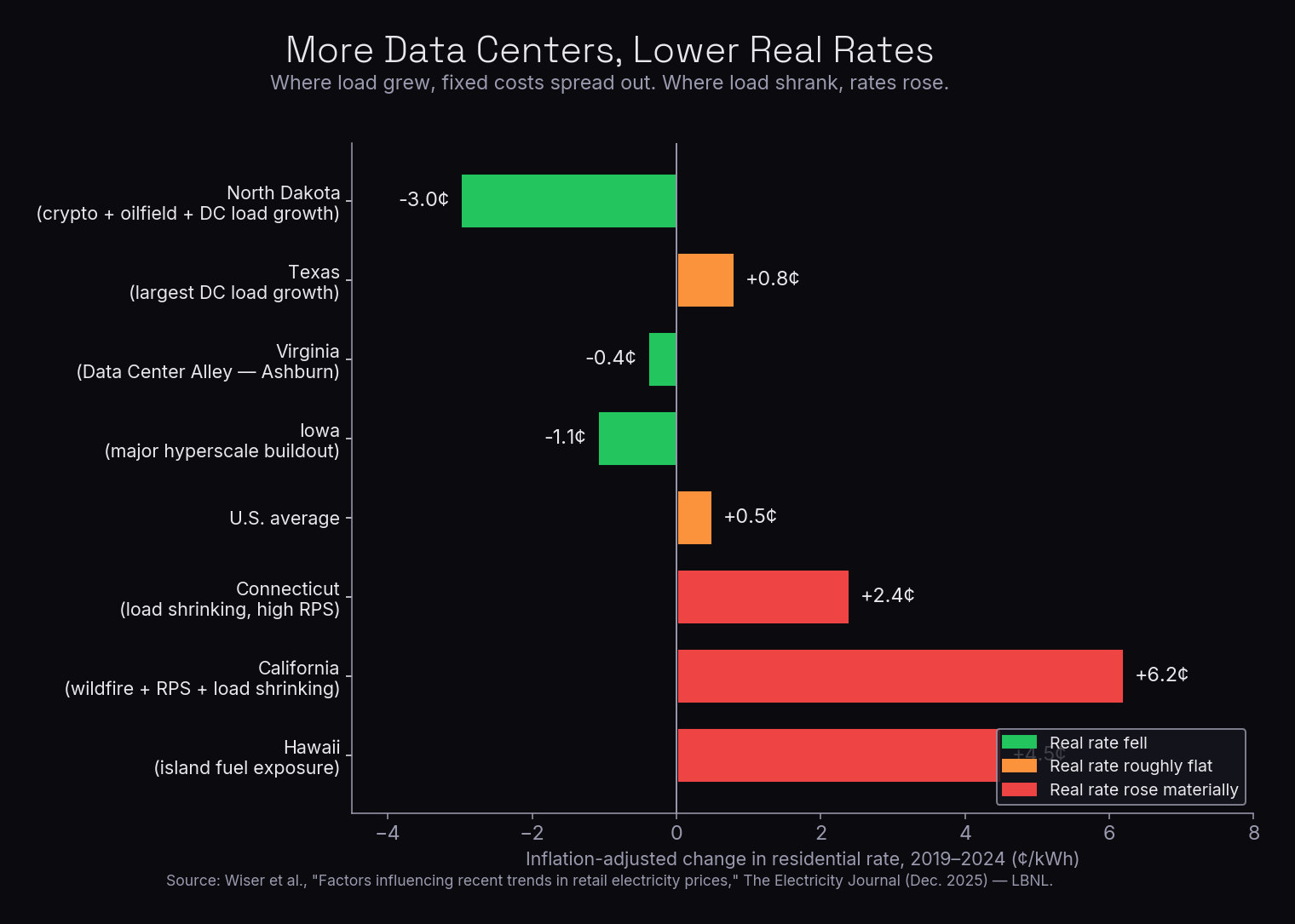
The mechanism is utility economics 101. A utility's fixed costs — wires, substations, generation under power-purchase agreements, transmission infrastructure — don't shrink when demand falls. They're recovered through per-kWh rates. So if total demand on the system rises and the new demand pays for the marginal capacity it needs, the existing fixed-cost base gets spread over a larger denominator, and the per-kWh rate falls. This is the same principle that lets a restaurant lower per-plate cost by filling more tables: the rent doesn't change.
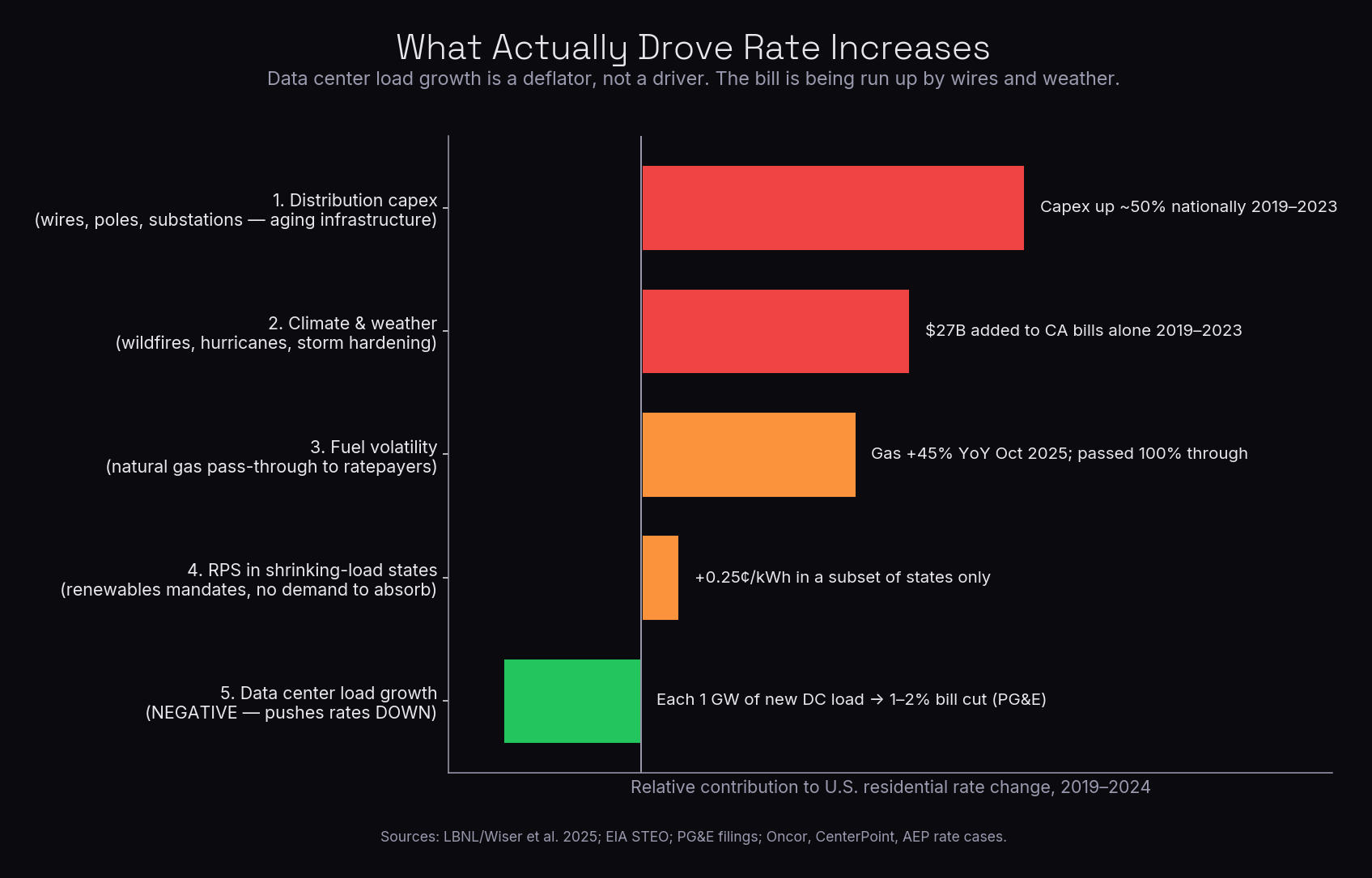
What actually drove rate increases? The Berkeley paper ranks five drivers. Data centers aren't on the list. Distribution capital expenditure — the wires and substations utilities have deferred since the 1990s — is #1, up about 50% nationally between 2019 and 2023. Climate and weather costs (California wildfires alone added $27 billion to ratepayer bills 2019–2023) are #2. Natural gas pass-throughs are #3. Renewable Portfolio Standards in states with shrinking load account for the rest, and only in a subset of states. The cable-news talking point that data centers and renewables are jacking up everyone's bills doesn't survive the regression.
The analogy for the public. When you spread the cost of a hotel across 200 occupied rooms instead of 100, the price per room goes down. Data centers fill the rooms. The reason your electric bill is rising isn't the new guest down the hall — it's the new roof on the building. And the storms that made the new roof necessary. And the gas that heats the lobby. The data center isn't the problem; it's the new guest paying their share of the existing fixed costs.
A second one-liner that works in a city council setting: "In every state that's grown data-center load fast, residential rates have fallen in real terms. The states with the worst rate problems — California, Connecticut, Hawaii — have almost no data centers. Don't confuse correlation with causation. The data tells the opposite story."
2. Do Data Centers Drain the Water Supply?
The technical case. Data-center cooling falls into two distinct technical buckets, and conflating them is the single most common error in public reporting. Evaporative cooling uses water as a thermal medium — water is evaporated, the phase change pulls heat out of the air, and the now-cooler air cools the servers. This is the high-water-use design. Closed-loop liquid or air cooling uses a sealed coolant circuit that never evaporates. Water is added once, at construction, the way a car's radiator is filled at the factory.
The industry's preferred metric is Water Usage Effectiveness (WUE), measured in liters of water per kWh of IT load. The industry-average WUE for evaporative-cooled hyperscale is about 1.8 L/kWh. Microsoft's 2024 fleet average is 0.30 L/kWh; AWS reports 0.19 L/kWh; Google and Meta come in around 1.08–1.12 L/kWh. Microsoft's next-generation closed-loop design, announced December 2024, hits a WUE of essentially zero — the company says it eliminates 125 million liters (~33 million gallons) of annual water use per facility versus its prior design. Barrio Energy's data centers use the same closed-loop architecture.
The arithmetic for a 10 MW facility — Barrio's reference small-campus size — is straightforward. At industry-average WUE, a 10 MW evaporative facility consumes roughly 41.6 million gallons per year. At Microsoft's best-in-class WUE, the same load draws ~6.9 million gallons. A 10 MW closed-loop facility — Barrio's design, Microsoft's new design, the direction the whole industry is moving — uses approximately 20,000 gallons total, one time, at construction. That is roughly one residential swimming pool. The facility then runs for thirty years without refilling.
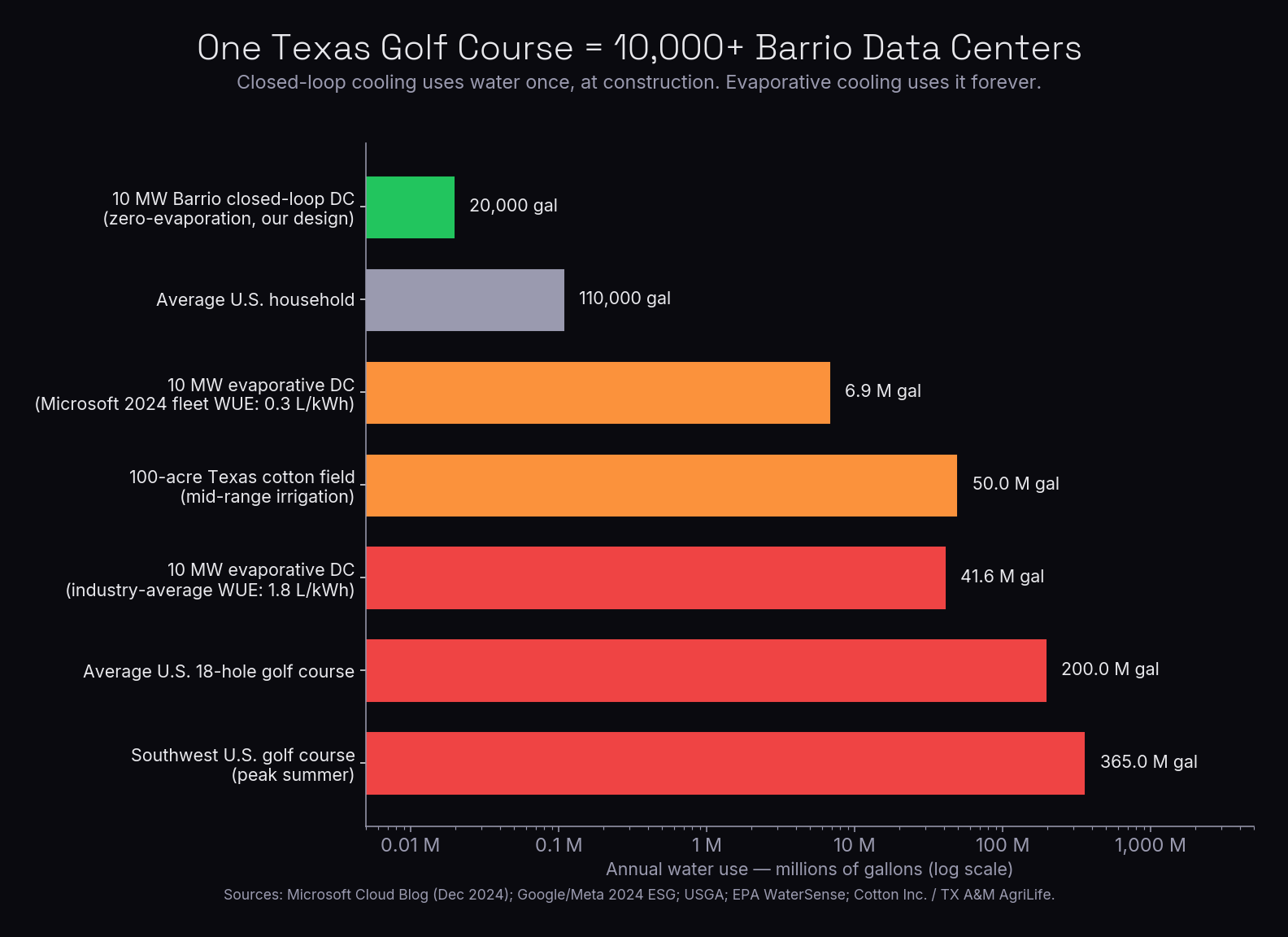
For perspective: the average U.S. 18-hole golf course consumes about 200 million gallons per year; a Southwest course in peak summer can hit 365 million. A single 100-acre Texas cotton field uses 32 to 65 million gallons per growing season. The average U.S. household uses about 110,000 gallons. A 10 MW closed-loop data center is closer, on annualized water use, to a single washing machine than it is to any of these. The "data centers are draining the aquifer" framing comes from extrapolating evaporative-design numbers — which are real, and which Microsoft, Meta, AWS, and Barrio have all moved away from — to a generation of facilities that no longer work that way.
The analogy for the public. A closed-loop data center uses water the way a car uses radiator coolant — you fill it once at the factory and it runs for the life of the vehicle. An evaporative data center uses water the way a swamp cooler does — it evaporates a continuous stream into the air. We build the first kind. The second kind exists, and the industry is rapidly retiring it.
The one-line version: "One 18-hole golf course in our region uses more water in a single year than ten of our data centers would use in their entire 30-year operating life. We're not the water problem. If anything, we're an argument against the water problem."
3. Where Do Data Centers Actually Get Built?
The technical case. Across every U.S. metro with a meaningful data-center footprint, the sites are sited in light industrial (M1) or equivalent zoning — the same category that hosts warehouses, distribution centers, light manufacturing, R&D labs, and self-storage. They are not, by ordinance or practice, sited in residential, mixed-use, or commercial-retail districts.
Ashburn, Virginia — the largest data-center cluster on the planet, with more than 100 facilities and roughly 70% of global internet traffic passing through it — permits data centers by right in three zoning categories: Industrial Park (PD-IP), General Industry (GI), and Mineral Resource–Heavy Industry. Data centers are not permitted in residential zones, period. Mesa, Arizona — the second-largest cluster in the Southwest — restricts them to General Industrial and High-Industrial zones only. The City of Chandler adopted a 2024–2025 ordinance codifying the same restriction.
The Texas pattern is identical. Plano's 46 MW Aligned DFW-01 facility at 2800 Summit Avenue sits inside the city's light-industrial corridor with a Specific Use Permit layered on top. Richardson's Digital Realty and CyrusOne campuses are in the I-M(1) Industrial / Telecom Corridor district. Crusoe's Stargate-affiliated 1,100-acre campus at 5502 Spinks Road in Abilene was annexed into city limits in 2021 specifically to access industrial zoning. IREN's 1,300-acre Sweetwater 1 campus sits on rural industrial land. Microsoft's San Antonio cluster spans Texas Research Park in Bexar County and ~1,100 acres of rural industrial land in Medina County.
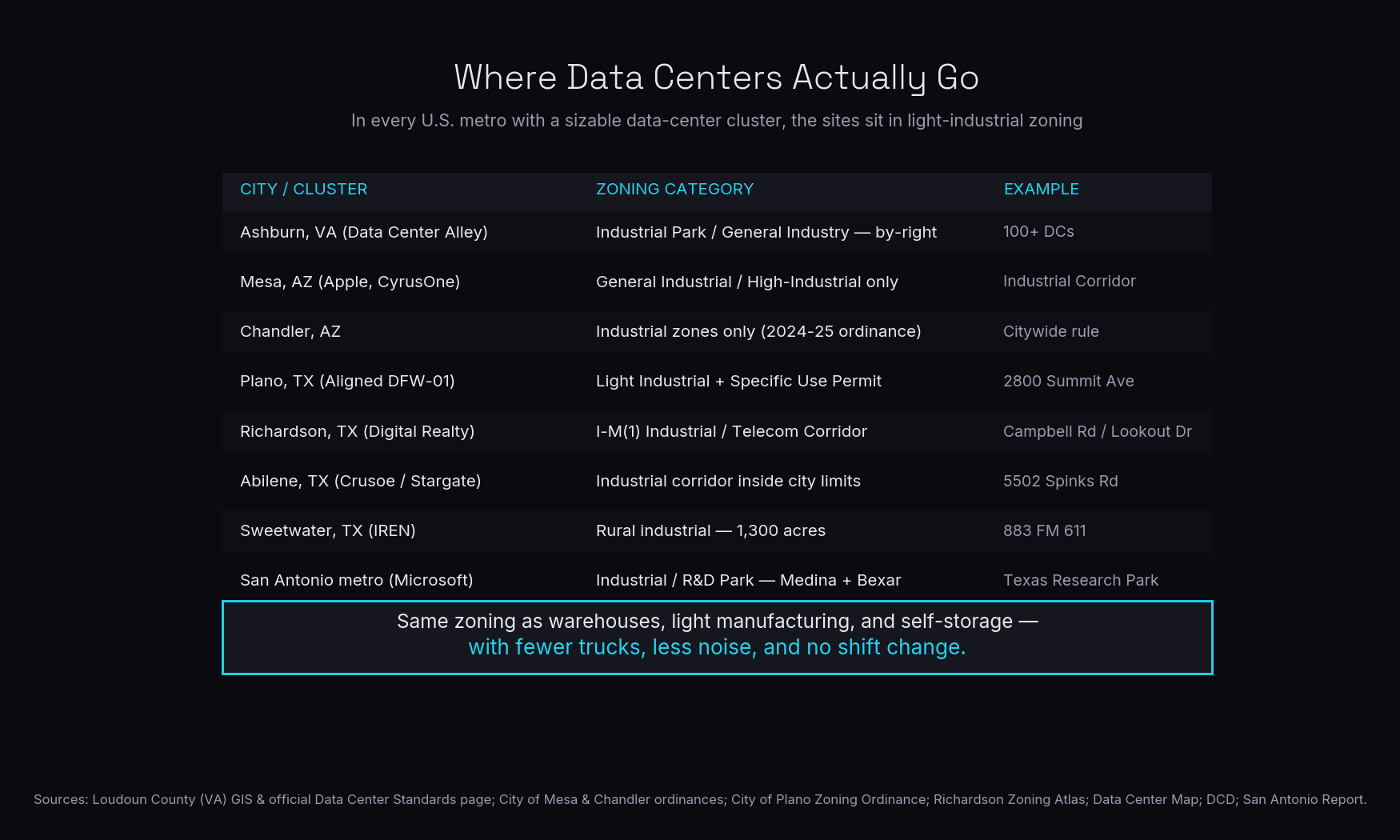
An important framing point: a modern data center is, by industrial-zoning standards, an unusually quiet, low-traffic, fume-free neighbor. The typical M1 facility nearby is a Class A warehouse that runs 50 truck deliveries a day, an auto body shop with paint VOCs, a self-storage complex with 24/7 vehicle traffic, or a light-manufacturing plant with shift changes. A data center has ~10 truck deliveries a month, a parking lot for a small tech staff, and rooftop cooling equipment regulated by the same noise ordinance as every other M1 use. The argument is not that data centers should be welcomed because they're industrial; it's that they are better neighbors than most of what already lives in industrial.
The cases where data centers generate real public controversy almost all share a structural feature: they are proposed for land that has no zoning at all. The Texas Tribune-covered Hill County moratorium earlier this month is the canonical example — the project was on unincorporated land outside any city's zoning authority, where Texas counties don't have general zoning power to channel industrial development. That isn't a data-center problem. That's a zoning-gap problem. In every city with a functioning M1 district, this conflict simply doesn't happen, because the rule is already in place: industrial uses go in industrial zones. Data centers are the most boring kind of industrial use.
The analogy for the public. Data centers go where Amazon warehouses go, where FedEx hubs go, where the cabinet shop and the steel fabricator go. We don't get built across the street from elementary schools, and the zoning code wouldn't let us if we tried. The neighbor you have right now — the one with the loading docks, the diesel forklifts, and the third shift — is louder, smellier, and more truck-heavy than a data center will ever be.
The one-line version: "Show me a data center in a residential neighborhood. You can't, because zoning law doesn't allow it. We go where warehouses go — and unlike warehouses, we don't have eighteen-wheelers on the dock at 4 a.m."
The Bigger Picture
The pro-data-center case isn't ideological. It's arithmetic. Texas now leads the country with 142 data centers under construction, narrowly ahead of Virginia. The industry produced about 61,000 direct Texas jobs in 2023 and generated $3.2 billion in state and local tax revenue in 2024 — outside the sales-tax-exempt portion. A single Hood County campus is projected to bring enough property-tax base to fund a new junior high school. These projects are not extracting from communities; they are paying for the wires, the roads, the schools, and — when the rate design works correctly — for the marginal grid capacity they require.
The honest pro-data-center position is not that there are no costs. It's that the costs are recoverable, the benefits are durable, and the alternative — Texas conceding the AI infrastructure buildout to Virginia, Arizona, or any of the half-dozen other states writing checks for it — is not actually an alternative anyone in this state should want.
Use the charts. Quote the LBNL paper. The data is on our side; the conversation is the only thing that hasn't caught up.
What to Watch Next Week
PUCT draft rule §25.194 comments. The Senate Bill 6 rulemaking on large-load interconnection and transmission cost allocation is where the technical version of "data centers paying their fair share" gets written into Texas regulation. Hyperscaler and consumer-advocate filings are running now.
Hill County moratorium litigation. Texas counties don't have general zoning authority; legal experts expect a challenge to the May 12 moratorium on standing grounds. If overturned, the case becomes a precedent for keeping industrial projects on industrial land — by ordinance, not by ban.
EIA Short-Term Energy Outlook update. The May STEO will refresh the 2026 retail rate forecast for the South region. Watch for whether load-growth dilution starts showing up in Texas residential rate projections.
Microsoft Phoenix and Mt. Pleasant pilot data. Microsoft's first closed-loop facilities come online in late 2027. Early instrumentation data from the pilots — water draw, PUE, thermal performance — will be the first independent confirmation of the zero-evaporation design at hyperscale.
Disclaimer: The Grid Report is Barrio Energy's market intelligence product. Barrio Energy develops behind-the-meter, closed-loop data center infrastructure in Texas. Nothing here is investment advice. Links go to primary sources wherever possible; form your own view.